• HOME
  • About Me
  • Events
  • BLOG
  • Publications
  • Interviews
  • Contact

BEVAN THOMAS

~ Writer, editor, storyteller

BEVAN THOMAS

Category Archives: Welsh Folklore

The Welsh Arthur

08 Tuesday May 2018

Posted by Bevan Thomas in Welsh Folklore

≈ Leave a Comment

Tags

King Arthur

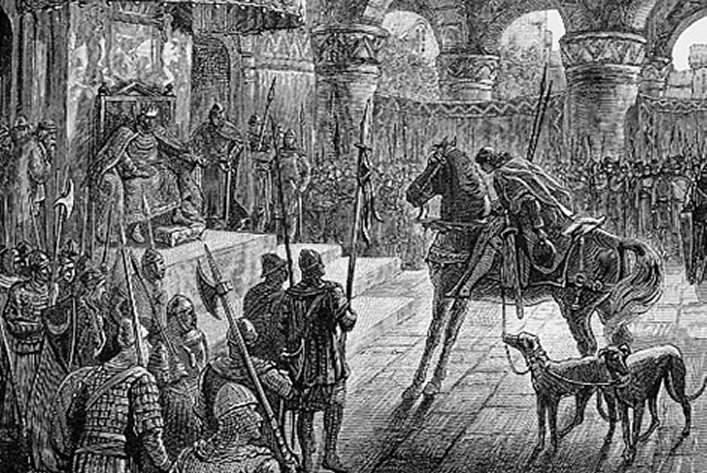
Culhwch meets King Arthur

When I started doing research for Wizards of Wales (which I have now renamed Enchanters of Britain), I started taking a look at a lot of Welsh folktales a lot more closely than I had done before. In exploring them, especially the bizarre romp “Culhwch & Olwen,” I discovered a version of King Arthur that I hadn’t previously known existed, despite being a big King Arthur fan ever since I was a child. Sadly, the original Welsh version of King Arthur has been eclipsed by the knightly romances of Chrétien de Troyes and Sir Thomas Mallory, and by the modern obsession with finding the “real” King Arthur, some British or perhaps Sarmatian warchief fighting against the Saxons back in the 5th century of history. Even the rpg supplement GURPS Camelot, when describing the different interpretations of King Arthur, talked about the historical Arthur, the Arthur of the Romances, and the Arthur of modern pop culture, but never mentioned the Arthur of Welsh myth.

But if you look back at the original surviving Welsh fragments, they are more fantastical than Mallory not less, presenting a folk hero in the style in Heracles or Sigurd, rather than a historical general. “Culhwch & Olwen” is the only early Arthurian folktale that survives in its (more-or-less) entirety, and it presents a court of Arthur filled with demigods, such as the fairy king Gwyn ap Nudd and Manawydan ap Llyr, and with superpowered heroes, with powers ranging from being able to stamp mountains flat to setting themselves on fire.

So what defines the original Welsh Arthurian stuff?

  1. Fantastical. Fantasy elements surround the characters. Arthur’s champions (even his dog!) have superpowers and they battle fairies and demigods. There are talking animals, armies of werewolves, dragons, numerous giants, and wide variety of wizards and magical artifacts. Not all the stories even take place in the regular world — the heroes travel into hidden enchanted valleys all the time and frequently enter Annwn, the Otherworld.
  2. Pre-Chivalry. Though the time period of the original stuff is not really defined, it is still clearly not the Middle Ages. There are no tournaments or courtly love, no jousting knights. It’s dark ages warriors going on strange personal quests, contending with the remnants of pre-Christian imagery and slaying monsters less for chivalric reasons and more for personal glory. The later pseudo-historical writings of Geoffrey of Monmouth and others has Arthur battling the invading Saxons and Angles; though not part of the original stories, it still fits very well with it.
  3. Welsh. The heroes are not English and they certainly do not have the French names and titles that appear in the Romances (Lancelot du Lac, Morgan la Fey, Beaumains, etc.). They are Brythons, the people who became the Welsh and the Cornish, and they have a strong cultural identity.

Perhaps the last is the most important point about the early Arthur stories. They were cultural stories presenting the heroes of the Brythonic people, heroes that defined Welsh and Cornish identity. Though the English later appropriated Arthur for their own purposes, in the original stories he was clearly Brythonic and Celtic. A hero of my ancestors rather than my ancestors’ conquerors.
Welsh King Arthur

02 Wednesday May 2018

Posted by Bevan Thomas in Welsh Folklore

≈ Leave a Comment

Tags

King Arthur, Wizards of Wales

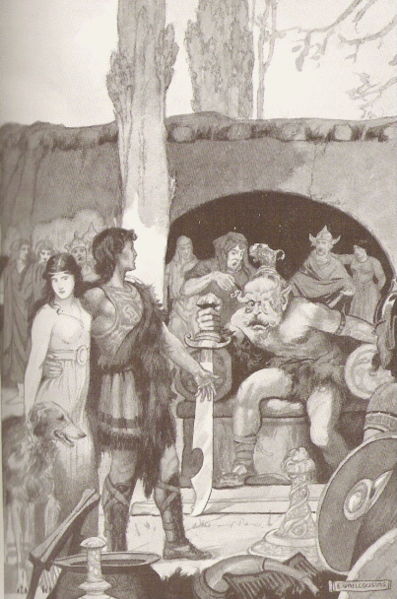
Culhwch & Olwen

I haven’t been posting much here recently, largely due to all the numerous projects I’ve been engaged with. I was working on a novel last year and thinking to myself that I really hoped to get it done soon because the thing I really wanted to work on was “Wizards of Wales,” an adaptation of Welsh myths looking at various wizards and enchanters. Then I realized “why I am I working on a book I’m not interested in when I could be focusing on the one I am interested in?” Thus I switched over from Guardian of the Garden City to Wizards of Wales. Then while researching for that book, I got really interested in the Welsh version of King Arthur, which has surprisingly little influence on later King Arthur retellings. Even stories that claim to be about the “real” King Arthur are more interested in simply moving the events of Le Morte d’Arthur into a more historical time period (Mists of Avalon) or adapting Geoffrey of Monmouth or other early pseudo-historical Arthurian works but ignoring the actual Welsh stuff (Mary Stewart’s Crystal Caves series).

This is a real shame, as the original Welsh stuff is fascinating. Its champions possess bizarre powers and strange personalities, fighting giants and monsters in mysterious quests. In Culhwch & Olwen, the only original Welsh Arthurian story to survive in its entirety, Arthur’s court includes various demigods, such as Manawyddan ap Llyr (of the Mabinogi), Gwyn ap Nudd (king of the fairies), and Morvran (son of the goddess-witch Ceridwen), as well as figures with such a range of powers as superspeed, superstrength, flight, fire-generation, and lips so long that the top lip can be curled back and worn like a hat. It feels less like a court of medieval knights and more as a more bizarre version of the Argonauts of Greek myths or the Avengers. It is crazy and awesome, full of magic and passion — truly the folktales of the Welsh people’s most famous folkhero, rather than Norman-style knights in armour.

Trying to piece together all the old Welsh stories and fragments, combining them together into a coherent narrative, has been a really fascinating experience, and resulted in what was originally going to be one book on Welsh myths splitting into two: Wizards of Wales and Arthur, King of the Brythons. It’s something I’ll be exploring further in this blog, looking at aspects of King Arthur that sadly are rarely explored.

Newer posts →


    Name (required)

    Email (required)

    Phone

    Comments

    Spam Verification 

    captcha  

    ♣ BLOG

    • Fairy Tale Flash Fiction: The Wounds of Selene
    • Fairy Tale Flash Fiction: Owain’s Ravens
    • Fairy Tale Flash Fiction: King Arthur’s Mood
    • Fairy Tale Flash Fiction: The Campfire
    • Fairy Tale Flash Fiction: Owain and Modron

    Proudly powered by WordPress Theme: Chateau by Ignacio Ricci.